Penpalling & Letters

Saturday, 28 May 2011

Corners of Warsaw

Hello from Polska! As you can guess, we are in Europe, in the east of this continent, in a country we already travelled to some months ago. Its coastline, in the north, is bathed by the Baltic Sea and, at the south, the Tatra Mountains are the natural border with some of its neighbouring countries. Have you already guessed where we are located today in this new travel around the world?

Hello Agnieszka and welcome to Penpalling & Letters! What a pleasure to have you here today, in Travelling around the World sharing Cultural Heritage, Folklore and Background section! Would you like to share your penpalling experiences with us?

Hello everybody! As you already know my name is Agnieszka and I come from Warsaw, the capital of Poland, which is situated in the central area of my country and it is the biggest city, too.
I have been penpalling since I was fourteen. I met my first penpals during vacation. My Polish penpal and I have neighbouring summer houses by the lake, where we were spending each vacation and wanted to keep in touch during the year through letters. We are friends till today; she lives in Warsaw so we see each other sometimes and still go for vacation to our place. My first foreign penpals I met during summer language courses in England. I was corresponding with two Italian and one Spanish girls but, unfortunatelly, it did not last long. I had a break from penpalling since the Internet interrupted in it. I had never written to anyone who I haven't met personally until two years ago, when I found the "Interpals" website and met new wonderful penpals there! Even if I am not into "Postcrossing", I love getting postcards from my friends and I always send some, too, whenever I go somewhere or from my homecity, indeed. I guess that like everyone in "our small penpalling world" I like colourful stationery. Sometimes I paint the envelopes myself! I am not sure if I can say I collect stationery or stickers, because it is all to be used and I don't buy anything with the intention to keep it for myself. At the moment I am not looking for new penpals, but you can find me at my Blog:


As you already know, I come from Warsaw, the capital of Poland. Warsaw has over 1,700,000 inhabitants nowadays. Its symbol is the Mermaid. She is in the city's coat of arms: "Warsaw's Coat of Arms" and there are two monuments of the Mermaid in Warsaw, as well.
According to the legend, a Mermaid swimming in the sea stopped on the riverbank near to the Old Town to rest. She found the place so admirable that she decided to stay. Local fishermen living nearby noticed that something was creating waves, tangling nets, and releasing their fish. Although their original intention was to trap the offender, they fell in love with the Mermaid upon hearing her singing. Later, a rich merchant trapped the Mermaid and imprisoned her in a wooden hut. A young fisherman heard the Mermaid's cry and with the help of his mates released her, whereupon she declared her readiness to offer fishermen her help whenever it would be needed. Ever since, the Mermaid, armed with sword and shield, has been ready to help as well as protect the city and its residents.

I could write pages about Warsaw because it is a big city, which means that there are many things to see and it has a rich history, too. Therefore, I decided to choose a couple of most important things to show you this time!

The Old Town is the historic centre of the city, and it is listed in the UNESCO World Heritage Sites List. It was reconstructed after World War II, when it was totally destroyed. In the Old Town you can expect to see the Royal Castle, with a museum inside. In the middle of the square, in front of the Castle, there is Sigmunt's Column. On the top of it stands the King who moved the capital from Cracow to Warsaw. Walking through a narrow street you arrive to another square where one of the monuments of the Mermaid is. There are many cafes, "pierogarnias" (restaurants which specialize in making "pierogi" – our traditional and delicious meal) and a well-known confectionery. Rumours say it has the best ice-cream in the city. At least there is always a queue in front of it!

Łazienki Park is a 76 hectares park within the borders of Warsaw, with some historical monuments inside. One of them is the Palace on the Island, where the last King of Poland, Stanisław August Poniatowski, an art lover, used to organize Thursday Dinners to which he invited poets, painters and famous erudites. There is also a monument of Chopin, where during summer weekends free concerts take place. Not to make this post dry with facts, let me mention that in the park live, unafraid of humans, squirrels, which, if you give them peanuts, will eat from your hand!

The Palace of Culture and Science is the highest building in Poland (230 m), located in the very centre of Warsaw. It was built in the 50s as a "gift of the Soviet people to the Polish nation" by Stalin's initiative. On the 30th floor there is a terrace from where you can view the panorama of Warsaw. In the Palace there is the Congress Hall, a place where artists from all over the world perform, there is a lovely small cinema where you can watch films from different corners of the world, and also, all kinds of cultural events: fairs, exhibitions, conferences... are organized in this space. Each winter, next to the palace, a skating-ring opens. Regarding the architecture of the building, the opinions are divided, but whether it is positive or negative, the Palace is one of the city symbols, together with the Mermaid and Sigmunt's Column.

Thanks for taking part in Penpalling & Letters, Agnieszka! It was very interesting to read and learn about these places in your homecity, Warsaw! Feel free to participate again whenever you feel like it!

If you are interested in reading more articles featuring characteristics of our homelands don't forget to check: Travelling around the World sharing Cultural Heritage, Folklore and Background.

I am always looking for people who would like to take part into this section of the Blog: Travelling around the World. If you would like to write about your homeland don't hesitate to contact me at: penpallingandletters[at]gmail[dot]com and we will work on it!

Thursday, 26 May 2011

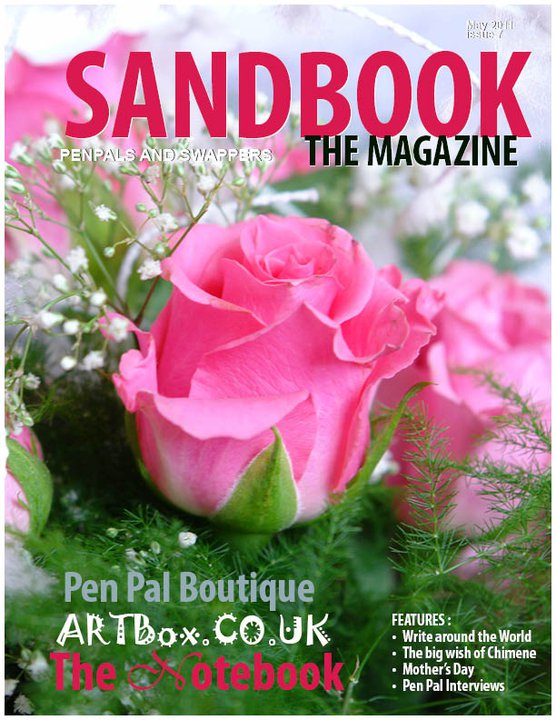
Sandbook Penpalling Magazine Issue 7

The seventh issue of the penpalling magazine edited and produced by Sandbook.Net Penpal and Swappers Site corresponding to the month of May is finally online. As always, it is on digital format and you can download it as a PDF file at the Sandbook.net website: Sandbook Magazine - Issue 7. Have you never heard before about this penpalling magazine? Did you miss any of the previous issues? You still can download them at: Sandbook Magazine Archive.

Together with the May issue, a new series of the Sandbook Booklets (Booklet 4) is online as well. If you are interested in getting it you can download it at the following link (it is on digital format as a PDF file, just like the magazines): Sandbook Booklet 4.

If you are interested in taking part in future issues of the magazine or the booklet check how to do it in this link: "What to do to participate in Sandbook Magazine".

As in previous occasions, issue number 8 will be online on the 11th June 2011 at: Sandbook.Net Penpal and Swappers Site. There will be a new Booklet coming out next month, too. Don't miss them! You will be able to read many interesting articles and news on penpalling and other different topics!

Monday, 16 May 2011

The Notebook (2004)


The Notebook is a 2004 romantic drama film starring Rachel McAdams, Ryan Gosling, Gena Rowlands and James Garner. It was directed by Nick Cassavetes and based on the novel of the same name by Nicholas Sparks. The Notebook was inspired by the story of the grandparents of Sparks' wife, who had been married over sixty years when Sparks met them. Sparks marvelled at how much the couple cared for each other, and wrote his novel as an attempt to describe such a love.

The Notebook is an epic love story which tells about lost opportunities due to insurmountable obstacles, about second chances, discrimination due to social strata, the true love that endures through time and overcomes the difficulties, the victory of love over the disease, even for a moment, or arranged marriages of convenience.

The narration, both in past and present, is full of strength, charm and deep, sometimes contradictory, feelings. The story captives the viewer from the very first moment and keeps its delight until the end. The special chemistry between the main characters adds an enchanting touch besides showing freshness and naturalness around them.

The story starts on the summer of 1940 in Seabrook, South Carolina. Allie Hamilton (Rachel McAdams) is an upper-class girl who is spending summer with her family in that coastal town. At the main festival, she meets Noah Calhoun (Ryan Gosling), a local boy who works at the lumber mill. Years later, an old gentleman reads the story of a couple written in a faded notebook to an old, sick lady...


- Why didn't you write me? Why? It wasn't over for me, I waited for you for seven years. But now it's too late.
- I wrote you 365 letters. I wrote you everyday for a year.
- You wrote me?
- Yes... it wasn't over, it still isn't over.

[Information taken from The Notebook, The Internet Movie Database, Wikipedia]

Sunday, 1 May 2011

Sandbook Penpalling Magazine Issue 6

The sixth issue of the penpalling magazine edited and produced by Sandbook.Net Penpal and Swappers Site corresponding to the month of April was delayed but is finally online. As always, it is on digital format and you can download it as a PDF file at the Sandbook.net website: Sandbook Magazine - Issue 6. Have you never heard before about this penpalling magazine? Did you miss any of the previous issues? You still can download them at: Sandbook Magazine Archive.

Together with the April issue, a new series of the Sandbook Booklets (Booklet 3) is online as well. If you are interested in getting it you can download it at the following link (it is on digital format as a PDF file, just like the magazines): Sandbook Booklet 3.

If you are interested in taking part in future issues of the magazine or the booklet check how to do it in this link: "What to do to participate in Sandbook Magazine".

As in previous occasions, issue number 7 will be online around the 11th May 2011 at: Sandbook.Net Penpal and Swappers Site. There will be a new Booklet coming out at the end of May, 2011 as well. Don't miss them! You will be able to read many interesting articles and news on penpalling and other different topics!

Friday, 29 April 2011

Mail Trivia XII


Did you know that...

a stamp showing a printing or design error has a higher value than the rest?

Tuesday, 26 April 2011

Easter traditions in Germany and Slovenia

Easter is the central feast in the Christian liturgical year, which commemorates when Jesus rose from the dead on the third day after his crucifixion. His resurrection is celebrated on Easter Day or Easter Sunday (also Resurrection Day or Resurrection Sunday). It is a moveable feast, meaning it is not fixed in relation to the civil calendar. Easter customs vary across the Christian world, but decorating Easter eggs is a common motif. In the Western world, customs such as egg hunting and the Easter Bunny extend from the domain of church, and often have a secular character. [Extracted from Wikipedia]

In this occasion, Katharina from Germany and Vesna from Slovenia wanted to share with us how Easter is celebrated in their homelands, so let's go on reading about Easter traditions in their countries!


"Katharina in Germany"

Here, in Germany, Easter is the first official countrywide long holiday weekend after Christmas. Good Friday and Easter Monday are bank holiday and all shops, offices... remain closed. Well, except for the ones at airports and train staions, of course! Usually, Easter is spent with family and/or friends. Many families have traditions in what they do for Easter. For my husband and me, it used to be a short trip to Italy, to beautiful Lake Garda, during seven years, but when "our" lovely little hotel closed a couple of years ago, we started staying at home for Easter, inviting our family and friends for a big Easter Brunch on Easter Monday. An Easter brunch always means a lot of nice things to eat. There will be all kinds of bread, cold-cut and cheese (as many Germans like to have bread with cheese or ham in the morning), jam and marmelades, cakes and muffins, but also warm dishes like a baked ham or turkey, a soup and salads. Some ingredients are a must for me at Easter, like carrots (because of the Easter bunny) and, above all, eggs.

Easter eggs are a symbol for Easter in many countries. But, here, in Germany, we do not only have chocolate eggs in all sizes, tastes and colours. We also use real eggs, first boiling them hard and then colouring them. In my family, this is usually done on Easter Saturday, and it is an event. You can buy colours for dying the eggs in any supermarket (but only around Easter time), however, you can also use nature's gifts for colouring eggs (like onion skin for a brownish colour, parsley or other herbs for green...). The eggs are dyed while they are still hot, and then they are put somewhere to dry and cool down. The last touch is greasing them (either with a bit of oil, margarine or even with a little piece of bacon fat) so they shine. They are then put in a little basket on a bed of (artificial) green grass where they wait to be eaten during the Easter days.
On Easter Sunday, in the very early hours of the morning, the Easter bunny visits every house especially if children live there. It hides chocolate eggs and little gifts in the garden for the children to search for. And when the weather forecast predicts rain, the bunny also goes inside the houses to hide its eggs and gifts indoors. And just in case you ever wondered why you find colourful eggs hanging in bushes in the front yards or gardens of German houses: that is needed to show the Easter bunny where the little children live and where to hide eggs (At least that is what my sister told her children!).

Decorations are very widespread for Easter. Now that winter is finally over, we like to decorate our houses, flats and gardens in spring colours and with spring and Easter symbols: eggs are hanging or sitting everywhere, together with bunnies, flowers and lambs. Preferred colours are pastel colours like yellow, light green, rose, pink... Nowadays most people buy these decorations in the shops where they sell more and more articles every year. For me as a child, however, Easter always was a time of crafting and painting. We would take real eggs, drill little holes in the upper and lower side, blow out the contents and then paint the eggs with whatever means available. Our preferred paint was mom’s nailpolish. In the end we put a little ribbon on the egg and hung then outside in a yellow-blooming bush in the front yard.
But not only houses and flats are decorated. In some areas it is a tradition to decorate public springs with eggs and green. This tradition is said to go back to 1909 and is more common in Southern Germany than in the North. The Easterly decoration of springs was meant to symbolize the meaning water has for life and growth.

Easter decorations at a spring in Maulbronn, Germany

It is said that the decoration of springs goes along with another tradition I have never experienced myself but only read about: the so-called Easter water. It is said that water scooped from a spring or ditch in the Easter night will have healing power and flatten/glaze one’s complexion. The water has to be scooped between midnight and sunrise and it has to be scooped and carried home in total silence.

From my teenage years in the North of Germany, I remember well the Easter bonfires that were held everywhere in the night of Easter Saturday. In Hamburg, the place where I grew up, the biggest bonfires were along the river Elbe. For these bonfires huge piles of wood were assembled (the higher and the bigger, the better), and on top of these piles a puppet made from straw (often a witch) was added. When it turned dark, the bonfires were started. It is a very old tradition, dating back to pre-Christian times. The idea behind these bonfire was to chase away the winter, to burn it out, and to ask for a rich harvest. In Christian times, this tradition prevailed and priest would light an Easter candle with the bonfire and carry it to the dark church, thus symbolizing Jesus Christ as the light for the world. I do not remember ever having seen the lightening of a candle, though. I recall the Easter fires as very social events with a lot of people who sat by the fires, talked and had a beer.

All in all, Eastertime is lovely here, in Germany! And I hope you enjoyed reading about it. But now I will go and put some colourful eggs in my little bush in the front yard so that the Easter bunny will find its way to my garden, too!


"Vesna in Slovenia"

Slovenia is a predominantly Catholic country and many families still celebrate it by going to church and following the Easter traditions. There are some Easter bunnies and chocolate eggs available at the shops (more and more each year), but they are not traditionally Slovenian even though some younger generations adopted them. I won't write about these though. I'll try to describe how my family and my husband's celebrated Easter in the past and how we two still celebrate it today. My grandma said – It is OK if you don't go to church, but if you consider yourself a Catholic, you should go to church at least twice a year: on Easter and Christmas!

Blessing of the fire

The preparations for Easter start the Sunday before Easter Sunday. We call it "cvetna nedelja" or translated: floral Sunday. People bring "butarica" to church and have it blessed then have it in the living area of the house/flat. Butarica is an arrangement of green branches and ribbons, but some people also bring small olive tree branches. Traditionally one of the boys who is still at school was the one who took butarica to church to be blessed, but not many people remember this tradition nowadays.

Butarica

On Holy Saturday everything is in preparation for Easter Sunday. Women bake potica (traditional Slovenian cake), cook ham, children colour eggs... All the food is then put in a basket and taken to church to be blessed. Food that must be in the basket: potica (represents the Jesus' crown), ham (represents Jesus' body), horse radish (represents the nails) and coloured eggs (traditionally they are coloured read and represent Jesus' blood drops). In my area we also put "zelodec" (stomach) in the basket. It is smoked pig stomach filled with bacon, eggs and bread filling, which is then baked.

Typical Easter baskets

Traditionally, the oldest unmarried daughter in the family was the one taking the basket to be blessed, but, again, not many people remember this tradition. At the time, women wait in the church for the food to be blessed, men and children make a fire in front of the church and burn a dried wood mushroom on it. After the priest blesses the food he goes outside and blesses the fire. The kindling mushrooms are then taken home and put on a fire so that the fireplace is also blessed. This tradition is not alive in the towns and cities because most households are heated with central heating, but in rural areas it's still practiced. We practiced it until a few years ago when we moved to town. I really liked it because it's a rare occasion when the whole village got together (even the people who only got home from towns for the holidays). I usually put the basket in our small church and then joined the men and also a lot of women outside to catch up and hear the latest gossip. In the evening it's time for Easter Vigil.

Potica

On Sunday morning it's time for church again and after the morning mass a breakfast for the whole family is prepared from the food that was blessed on Saturday. Traditionally it's only allowed to be eaten by hands (no cutlery) and it's not allowed to give any of the blessed food to cats. On this day the whole family should stay at home.
Easter Monday is a day when people visit their friends and family. During these visits they often exchange Easter eggs.

Zelodec

Thank you Katharina and Vesna!!! It was great reading your splendid articles! Hope to see you again in Penpalling & Letters!

Wednesday, 13 April 2011

"Cantinho das Artes e Lojinha da Inês" winner!

Inês from Cantinho das Artes e Lojinha da Inês was visiting Penpalling & Letters in March to tell us about her penpalling experiences and her abilities in the handcrafts world. Besides, Inês decided to organize a contest and offer the winner a fantastic butterfly cross-stitched bookmark and keyring. The contest ended a few days ago, and after deliberating together about choosing a winner (not easy at all), we came with a result, finally:

All the names of the participants were written in little pieces of paper

All the little papers were put inside a bag

An innocent hand took the papers out of the bag. The name which was out first for three times in a row was the winner this time!

The winner is Maria! Many congratulations Maria! You are so lucky to get these fantastic handmade items from Inês!!!
Thank you so much everybody for reading Inês' interview and supporting her, as well as for taking part in the contest! Inês is very happy and pleased with all the lovely comments received and the compliments regarding her participation in P&L!
More surprises will be on Penpalling & Letters in the future so remember to keep an eye on the Blog!

Thursday, 7 April 2011

Hamburg memories

I have recently received this postcard: "Hamburg: der russische Dreimaster "Mir" vor den St.-Pauli-Landungsbrücken während des Hafengeburtstages" or "Hamburg: Russian threemasted vessel "Me" in front of the Saint Pauli landing bridges during the anniversary of the harbour". This is a view of an area in the city of Hamburg, Germany. When I received it I felt nostalgia about the place. Some years ago I had the chance to study in Germany, in a city not far from Hamburg, under the Erasmus programme of the European Union. I spent an unforgettable time. Living abroad meant broaden horizons, thoughts and ideas, besides having the chance to meet people from many different countries of the world. It was interesting and enriching in all senses, as there aren't that many chances to live together with so many overseas at once. This is why sometimes I miss those times and that international atmosphere. I feel lucky I had the chance to live that experience because the memories are great! I was in Hamburg a few times, which I hope to visit some time in the future again... I have never lived in Hamburg but still feels nostalgia when I see pictures of this city or receive postcards from the places in Germany I had the chance to see with my own eyes. If it only was possible to go back in time...

Saint Pauli is one of the one hundred five quarters of the city of Hamburg and it is located in the Hamburg-Mitte borough. It is situated on the right bank of the River Elbe, being the "Landungsbrücken" a northern part of the port of Hamburg.
If you are interested in learning more about this quarter of Hamburg you always can check about it here: Saint Pauli.

The stamp enclosed belongs to a series called "UNESCO World Heritage Sites - Old Town of Regensburg". The old town of Regensburg was listed as an UNESCO World Heritage Site in 2006. These stamps were designed by Prof. Dieter Ziegenfeuter and issued on February, 3rd 2011. The motif represented is the Cathedral of Regensburg. The value of each stamp is 0,75€, valid to send letters up to 20g from Germany to any international destination at present. A detailed description of the stamp series can be found at Deutsche Post Filatelie.

Wednesday, 30 March 2011

Tips on letter writing III

Writing and receiving letters is an exciting activity. How many times have we found ourselves running to the letterbox to check if mail had arrived? In how many occasions the arrival of a letter cheered us up in a grey day and put a wide smile in our face? Isn't it great to exchange written papers and envelopes coming from far away? Don't you feel how special letters and correspondence between two people are?
As the penfriendship develops and you start exchanging more letters in a regular basis you might feel like sending some special stuff to your penpal and try to make your letters unique. Anything enclosed in a letter won't and will never be a replacement of the written words, but still is nice to enclose special features in a letter.
The first point to be taken into account is that you do not need to spend a lot of money in any singular thing you will be sending to a penpal nor be a too elaborated gift. There is no need to. Most of the time are the simple objects the ones which make a difference and make us feel special because our pal thought of us! So, try to inspire yourself and be creative!
And now you find yourself thinking which are the possibilities to send something special in the mail, something which is not too expensive, fits in an envelope, and at the same time, is cute and eye-catching. Just use your imagination as possibilities are endless.

How to make your letters unique? First of all, maybe you are one of those people who like drawing. I used to draw a lot when I was a child and a teenager and really enjoyed it back then. When drawing be sure you are creating the most personal decorated letter you could ever send. You don't feel like drawing? There are still lots of possibilities to personalize a letter: you can use stickers, rubber stamps showing different motifs, glitter, glitter pens, colouring pencils, water colour pencils, colour decorative stencils, quotes...
Another possibility is to design and print your own letter-paper. You can work on a graphics editing computer program until you obtain the wished design. Remember typical features and symbols of your homeland to decorate the letter here. They will surely transmit the essence of your homeplace.
What else is it possible to enclose in a letter? Remember characteristic stuff from your country. Perhaps this is not so easy to think about at first. We are too used to our own stuff and it usually happens that features which are common for us might surprise a person from another land, just because that specific thing cannot be found in their place. Again, it is not about an expensive gift. Have you thought about natural stuff? For example, drying and pressing a tree leaf or a flower? What about sending sand from your favourite beach, dunes or from the shores of a nearby lake?
Some other items which can be part of a letter are: postcards, used stamps, pictures, stationery (letter paper, pens, envelopes, stickers, deco-tape...), newspaper/magazine-cuttings, magnets, key-rings, bookmarks, CDs/DVDs of your favourite music or favourite movies, transportation tickets, telephone cards, maps from the city/place you live, brochures, tea-bags...

Despite it is exciting to send and receive additional stuff by post it should never be expected or demanded. It is very ugly to request specific stuff and gifts to penpals in certain countries, simply because you cannot find such items in yours. If it is a fair swap, it becomes an agreement between two people, otherwise don't be greedy and thoughtless!
Make sure you are sending stuff because you feel like it, because it is your personal decision and you wish to surprise your penpal; not because your penpal is demanding stuff all the time and you don't want to lose this penfriend. Also, consider that if you are sending a gift because it is your penpal birthday or it is a special celebration, don't send expensive stuff through the post. Maybe your penpal cannot afford the same stuff back and might feel embarrassed when receiving your parcel. Also because some packages never arrive to destination...
Finally, be careful when sending stuff to certain countries and cultures different to yours. Maybe the item can be inappropriate or considered of bad taste by your pal.

As you can see the possibilities to send additional stuff together with a letter are endless. You only need a little bit of inspiration, imagination and creativity!

If you are looking for advice on penpalling check: "Tips on letter writing".